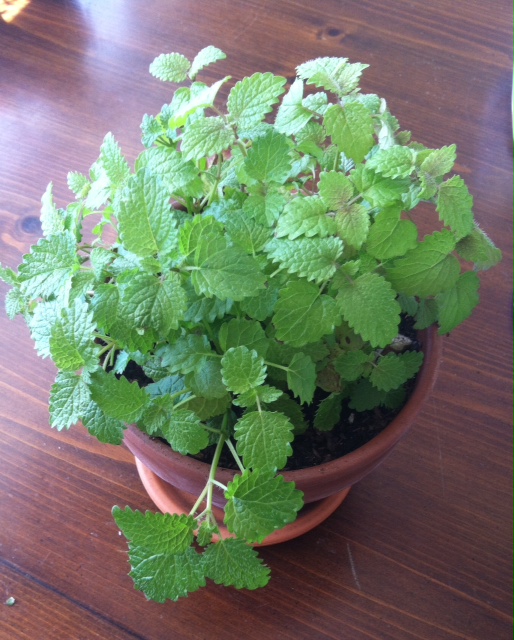
Although the coldest winter you ever spent may have been a summer in San Francisco, for the rest of the Northern Hemisphere we are moving into the warmer season, a time ruled by Pitta, the fire dosha. Pitta types run warmer–physically, mentally, and emotionally. Therefore, Pitta season is the summer season. Especially if you have a lot of Pitta in your constitution, it is important to take measures to cool off as the weather heats up. Lemon balm is a pleasant herb for such purposes. It is delightful to smell and taste and though it’s initial flavor is hot, sweet, and distinctively lemony, it’s overall effect on the body is cooling. It is also mildly calming to the nerves, helps settle the stomach, and can help induce sweating (leading to further cooling off). You can take lemon balm as a tincture, but if you pick the leaves fresh it makes a great tea. You can also used dried leaves for a tea. Lemon balm loves the sun, so if you grow it at home, give it as much direct sunlight as possible (up to 5 hrs. a day). For a refreshing summer tea, combine fresh lemon balm leaves with fresh mint leaves, steep for an hour, and enjoy at room temperature.
Herb of the Week: Ashwagandha
For those versed in Ayurveda and herbology, I imagine Ashwagandha would make it on the short list of herbs to take if stranded on a desert island. This warm and nourishing herb has a powerful tonifying effect and is a panacea for Vata disorders. Ashwagandha is a nervine tonic and nervine sedative, a muscle tonic, a respiratory tonic, boosts male libido, and is considered adaptogenic–meaning it helps us resist stress. It is warm and slightly oily, hence its value in balancing Vata. (Vata is aggravated by anything light, dry, cold, and mobile…think salad and air travel in the winter). If you suffer from weakness, anxiety, burnout, or a sleep disorder, Ashwagandha may be a good herb for you. You can take it in tincture form for a faster effect on the nervous system. If you are looking to build or repair tissue, take it in whole powdered form (you can mix it in hot water or warm milk or take as a capsule). Ashwagandha combines nicely with other tonic herbs such as Shatavari and Gotu Kola. If you have a lot of Pitta in your constitution, use caution because this herb does have a heating effect.
Herb of the Week: Rose
“I read in a book once that a rose by any other name would smell as sweet, but I’ve never been able to believe it. I don’t believe a rose WOULD be as nice if it was called a thistle or a skunk cabbage.â€
― L.M. Montgomery, Anne of Green Gables
This is a quote from one of my favorite childhood books, Anne of Green Gables. As is evident, the protagonist, Anne, understood something special about the rose. Indeed, roses are not only beautiful, they have symbolic and medicinal significance as well.
Roses are especially beneficial for Pitta due to their cooling nature. Their sweet, nourishing qualities also benefit Vata. Rose water is used in puja (devotional ceremony) and I like to keep it around the house as a refreshing skin spray. Rose water is moistening, and it is reputed to protect one’s energetic fields. Dr. Lad and Dr. David Frawley write of rose water: “It opens the mind and heart and is cooling and refreshing to the eyes” (Yoga of Herbs). Indeed, pure rosewater can be used safely as an eye wash.
Taken internally, rose can be used as a tonic. Roses also cool inflammation. For regulating menses and clearing blood stagnation, take rose with hibiscus or safflower.
Herb of the Week: Guduchi for Your Liver
Guduchi is a highly revered herb in Ayurveda, and one that I had never heard of before my studies in Ayurveda. However, it has become a staple in my herbal pharmacopeia. Guduchi is also know as “Amrit.” It is tridoshic, meaning it will not aggravate any of the doshas (constitutional types). It is a powerful rejuvenative and yet clears ama (toxins) at the same time. It helps liver cells regenerate and also helps decongest the liver. It stabilizes nerve function as well, so is useful in cases of nervous system disorder or imbalance. Dr. David Frawley and Dr. Vasant Lad write in Yoga of Herbs that Guduchi “increases our positive energy in conditions of debility like chronic fatigue syndrome” (p.243). Thus, Guduchi is good for treating and preventing chronic disease.
You may not see Guduchi at your local health food store, but you can order it rather inexpensively from Banyan Botanicals. Take a small amount of the powder in warm water or warm milk with a pinch of cardamom or other digestive spice.
